
Views: 222 Author: Yongting Publish Time: 2026-04-16 Origin: Site


As an OEM swimwear manufacturer in China, we've spent years helping global brands choose between private label and white label collections—and the best choice is rarely one‑size‑fits‑all. This guide walks you through the real trade‑offs in customization, cost, speed, and risk so you can select the model that fits your stage, budget, and brand vision. [laislabrand]
In swimwear, private label means the brand drives the product concept and owns the design, while the factory executes according to detailed specifications. You decide silhouettes, prints, fabrics, trims, and fit, and the result is an exclusive collection that only your brand can sell. [bidscube]
By contrast, white label uses pre‑designed styles developed by the manufacturer, which may be rebranded or slightly customized (usually labels, prints, or colors) for multiple buyers. It's faster and more budget‑friendly, but you sacrifice exclusivity because other brands can sell very similar—or even identical—looks. [thatcompany]

| Dimension | Private Label Swimwear | White Label Swimwear |
|---|---|---|
| Product control | Brand defines design, specs, and quality targets. (swimwearbali) | Factory defines core design and specs; brand selects from catalog. (swimwearbali) |
| Customization | High: styles, patterns, fabrics, hardware, fit, packaging. (swimwearbali) | Limited: mainly logo, labels, colors, sometimes prints. (swimwearbali) |
| Exclusivity | Exclusive designs linked to one brand. (swimwearbali) | No exclusivity; same base style sold to multiple brands. (swimwearbali) |
| MOQ & cost | Higher MOQs and development costs but stronger brand value. (swimwearbali) | Lower MOQs and entry costs, ideal for testing markets. (swimwearbali) |
| Time to market | Longer: needs design, tech packs, sampling rounds. (swimwearbali) | Faster: order from existing collection with minimal changes. (swimwearbali) |
| Brand positioning | Best for long‑term, differentiated brands. (swimwearbali) | Best for quick launches and price‑sensitive concepts. (swimwearbali) |
From an owner's perspective, your label strategy determines how customers perceive your quality, price, and uniqueness. A private label line supports storytelling around fit technology, sustainable fabrics, or signature silhouettes because you control the product from sketch to shelf. [swimwearbali]
With white label, you compete more heavily on speed and pricing, which can work well on marketplaces and for trend‑driven drops, but it is harder to build a truly defensible brand. Many successful swimwear businesses actually combine both approaches—starting with white label to validate demand, then layering in private label hero styles once they know what sells. [sundiveapparel]
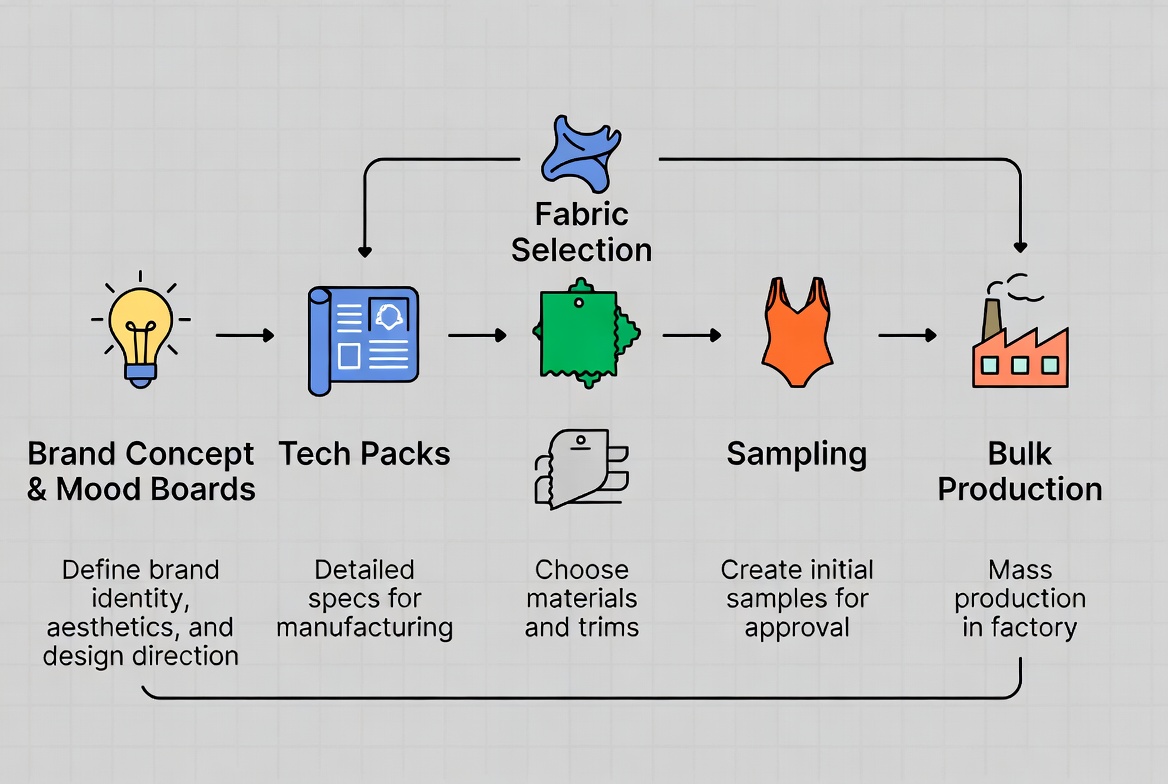
In a private label setup, you work with a factory to translate your ideas into technical and production‑ready swimwear. The process usually includes: [deepwear]
1. Concept and mood boards – Defining your brand DNA, target body types, and seasonal themes. [sundiveapparel]
2. Technical packs (tech packs) – Documenting measurements, construction, stitches, and trims for each style. [deepwear]
3. Fabric and trim selection – Choosing from performance blends (like nylon–spandex) or eco options such as recycled polyamide. [swimwearbali]
4. Sampling rounds – 1–3 fit and pre‑production samples to refine fit and appearance. [sundiveapparel]
5. Bulk production and QC – Final mass production with strict quality control checks. [yong-ting]
This approach demands more time and development investment, but the end product is uniquely yours and can justify higher retail prices and stronger brand loyalty. [svigloballtd]
- Unique brand identity: You own your silhouettes, prints, and details, which reduces direct price comparison online. [laislabrand]
- Better margins long‑term: Once styles are validated, you can reorder and iterate without paying design premiums every season. [swimwearbali]
- Alignment with sustainability and fit messaging: You can specify durable fabrics, inclusive sizing, and body‑friendly construction that match your brand values. [swimwearbali]
- Control over quality and compliance: It's easier to comply with testing and retailer standards when specs are documented from the start. [yong-ting]
Private label is not the easiest starting point if you're cash‑constrained or new to product development. Higher MOQs, longer lead times, and the need for strong tech packs can create risk if you are unsure about demand or sizing. [svigloballtd]
Best suited for:
- Growing DTC brands aiming for premium positioning. [mmsclothing]
- Retailers with established audience and sell‑through data. [thatcompany]
- Founders who want long‑term equity in a distinctive product line. [bidscube]
With white label swimwear, you select ready‑made styles from a manufacturer's catalog and place orders with your logo, labels, and packaging. Often, you can choose among existing colorways or prints, but the core pattern and construction are set. [laislabrand]
This model cuts out design and extensive sampling, which is why it is popular for:
- First‑time founders testing the market. [mmsclothing]
- Influencer and capsule collections that must launch quickly. [mmsclothing]
- Retailers focused on price‑sensitive customers. [thatcompany]
- Lower upfront cost: No need to pay for patterns, grading, or extensive development. [bidscube]
- Lower MOQs: Ideal when you want to test SKUs without overstocking. [svigloballtd]
- Faster time to market: You can launch within weeks instead of months. [deepwear]
- Simplified decision‑making: Choosing from a curated line avoids "blank page" design stress. [swimwearbali]
Because white label collections are sold to multiple buyers, there is no exclusivity and limited ability to adjust fit or pattern. Price wars are common because competing sellers may offer the same or similar designs in the same marketplaces. [laislabrand]
Best suited for:
- New brands validating niches, such as plus‑size, surf, or resort lines. [sundiveapparel]
- Sellers on marketplaces who win through smart pricing and photography. [thatcompany]
- Seasonal or event‑based collections that do not need long‑term distinctiveness. [mmsclothing]

Dongguan Yongting Clothing Co., Ltd. is a long‑established OEM/ODM swimwear manufacturer in China, producing up to 200,000 pieces per month for global brands and retailers. Our 3,000 m² factory and experienced team have supplied international names such as large format retailers and specialized sports brands, which gives us a clear view of which label model works at different stages. [sinofinetex]
From a manufacturer's perspective, both private label and white label can be successful strategies if expectations are clear:
- For private label clients, we encourage detailed tech packs, clear size ranges, and enough lead time for sampling. [yong-ting]
- For white label clients, we help them select proven styles and advise on MOQ and colorways to balance risk and variety. [yong-ting]

From an industry and founder standpoint, you should align your label choice with your budget, risk tolerance, and growth horizon. Use the following checklist as a practical decision tool: [svigloballtd]
Choose private label if most of these are true:
- You want to build a long‑term brand with recognizable silhouettes. [swimwearbali]
- You can invest in development, sampling, and higher MOQs. [deepwear]
- You have a clear niche (e.g., high‑performance surf suits, modest swimwear, adaptive swimwear). [laislabrand]
- You need control over fabric performance and fit for demanding customers. [sundiveapparel]
Choose white label if most of these are true:
- You want to test ideas quickly without committing to large inventory. [mmsclothing]
- You are comfortable focusing on branding, content, and sales more than product development. [bidscube]
- You sell on marketplaces where multiple brands can carry similar styles. [thatcompany]
- You prioritize cash flow and rapid rotation over long‑term style ownership. [bidscube]
Whether you choose private label or white label, your experience with the factory will be smoother if you follow a structured process. [yong-ting]
1. Clarify your business model and audience
Define your target region, channels (DTC, wholesale, marketplace), and price range before approaching factories. This information lets your manufacturer recommend the right fabrics, constructions, and label model. [deepwear]
2. Request catalogs and capability overview
Ask for style catalogs, size charts, fabric libraries, and MOQ information to understand what is realistically achievable. Experienced manufacturers like Yongting provide structured documentation and clear MOQ tiers for both private label and white label options. [yong-ting]
3. Start with limited styles and sizes
To control risk, begin with a focused range—perhaps 3–6 core styles and a curated size curve. This approach helps you build feedback quickly and avoid tying up too much capital in untested designs. [sundiveapparel]
4. Prioritize sampling and fit
Even with white label, ordering samples and doing fit tests on your target customers is critical to avoiding returns later. For private label, expect 1–3 sampling rounds; each iteration should move closer to your target fit and aesthetic. [deepwear]
5. Lock in production details in writing
Confirm prices, lead times, packaging, labeling requirements, and quality standards before placing bulk orders. A professional OEM partner should document this clearly and keep communication channels open throughout production. [yong-ting]
Emerging and established brands often need different mixes of private label and white label. [svigloballtd]
For startups and first‑time founders:
- Start with white label to validate your niche, price point, and audience. [swimwearbali]
- Use high‑quality photography, strong copywriting, and community building to differentiate even when styles are shared. [swimwearbali]
- Once you see consistent winners, transition those styles into private label versions with improved fit, unique prints, or better fabrics. [laislabrand]
For established brands and retailers:
- Anchor your line with private label hero products that embody your brand identity. [mmsclothing]
- Supplement with white label for trend‑driven or promotional ranges that need fast turnaround. [swimwearbali]
- Use your data (sell‑through, returns, reviews) to refine specs with your OEM partner season by season. [yong-ting]

As a Chinese OEM/ODM swimwear specialist, Yongting is structured to support clients at different scales and brand maturity levels. Our production capacity, experienced pattern makers, and long‑term partnerships with global brands allow us to offer flexible paths: [sinofinetex]
- For white label, we provide curated collections with low MOQs, proven fits, and fast lead times, ideal for startups and seasonal drops. [sinofinetex]
- For private label, we work closely on tech packs, sampling, and grading to deliver exclusive collections that match your brand DNA and retailer requirements. [yong-ting]
If you are not yet sure which approach suits you, our team can review your budget, timeline, and sales channels and recommend a hybrid roadmap—for example, white label in year one and increasingly private label from year two onward. [sinofinetex]
Talk to a Swimwear OEM Expert at Yongting!
1. Is private label swimwear always better than white label?
Not necessarily; private label offers more control and exclusivity but requires more investment, while white label is better for quick tests and tight budgets. [svigloballtd]
2. Can I start with white label and later switch to private label?
Yes, many brands begin with white label to find best‑sellers, then develop private label versions with unique cuts and prints once they understand their customers. [laislabrand]
3. What MOQs should I expect from an OEM swimwear factory in China?
MOQs vary, but reputable manufacturers often offer lower MOQs for white label and higher ones for private label to cover development and production efficiency. [yong-ting]
4. How long does it take to launch a private label swimwear collection?
Allow several months for private label, including design, sampling, and production, whereas white label can often ship significantly faster thanks to existing patterns and fabrics. [sundiveapparel]
5. How do I choose the right OEM factory for my swimwear brand?
Look for proven capacity, clear communication, quality control systems, and experience with your target markets; factories like Yongting that already serve international labels usually understand testing and compliance needs. [sinofinetex]
1. Swimwear Bali – "Private Label vs White Label Swimwear". https://swimwearbali.com/private-label-vs-white-label-swimwear/ [swimwearbali]
2. La Isla – "White Label Swimwear vs. Private Label Swimwear". https://laislabrand.com/journal/article/white-label-swimwear-vs-private-label-swimwear [laislabrand]
3. SVIGlobal – "White Label vs Private Label: What Are the Main Differences". https://www.svigloballtd.com/sourcing/white-label-vs-private-label/ [svigloballtd]
4. BidsCube – "Private Label vs White Label: Key Differences Explained". https://bidscube.com/blog/private-label-vs-white-label/ [bidscube]
5. That Company – "White Label vs Private Label – What's the Difference?". https://www.thatcompany.com/white-label-marketing/what-is-white-label/white-label-vs-private-label [thatcompany]
6. Sundive Apparel – "Complete Guide to Custom Swimwear Manufacturing for Startups". https://www.sundiveapparel.com/blog/15-essential-steps-in-the-complete-guide-to-custom-swimwear-manufacturing-for-startups [sundiveapparel]
7. Deepwear – "Swimwear Manufacturing: Everything you need to know". https://deepwear.info/blog/swimwear-manufacturing/ [deepwear]
8. Swimwear Bali – Sustainable Manufacturer Overview. https://swimwearbali.com [swimwearbali]
9. MMS Clothing – "11 Best Swimwear Manufacturers for Startups & Growing Brands". https://mmsclothing.com/11-best-swimwear-manufacturers-for-startups-growing-brands/ [mmsclothing]
10. Sino Finetex – "Who Are the Top Bikini Manufacturers in China?". https://sinofinetex.com/who-are-the-top-bikini-manufacturers-in-china/ [sinofinetex]
11. YongTing – "Swimwear Knowledge". https://www.yong-ting.com/Swimwear-Knowledge-ic3956646.html [yong-ting]
12. YongTing – Official Website. https://www.yong-ting.com [yong-ting]


